Data Analytics Career for Freshers: Skills & Growth

T
Tech Spartans Blog Manager
Published on October 14, 2026 • 8 min read
2 Views
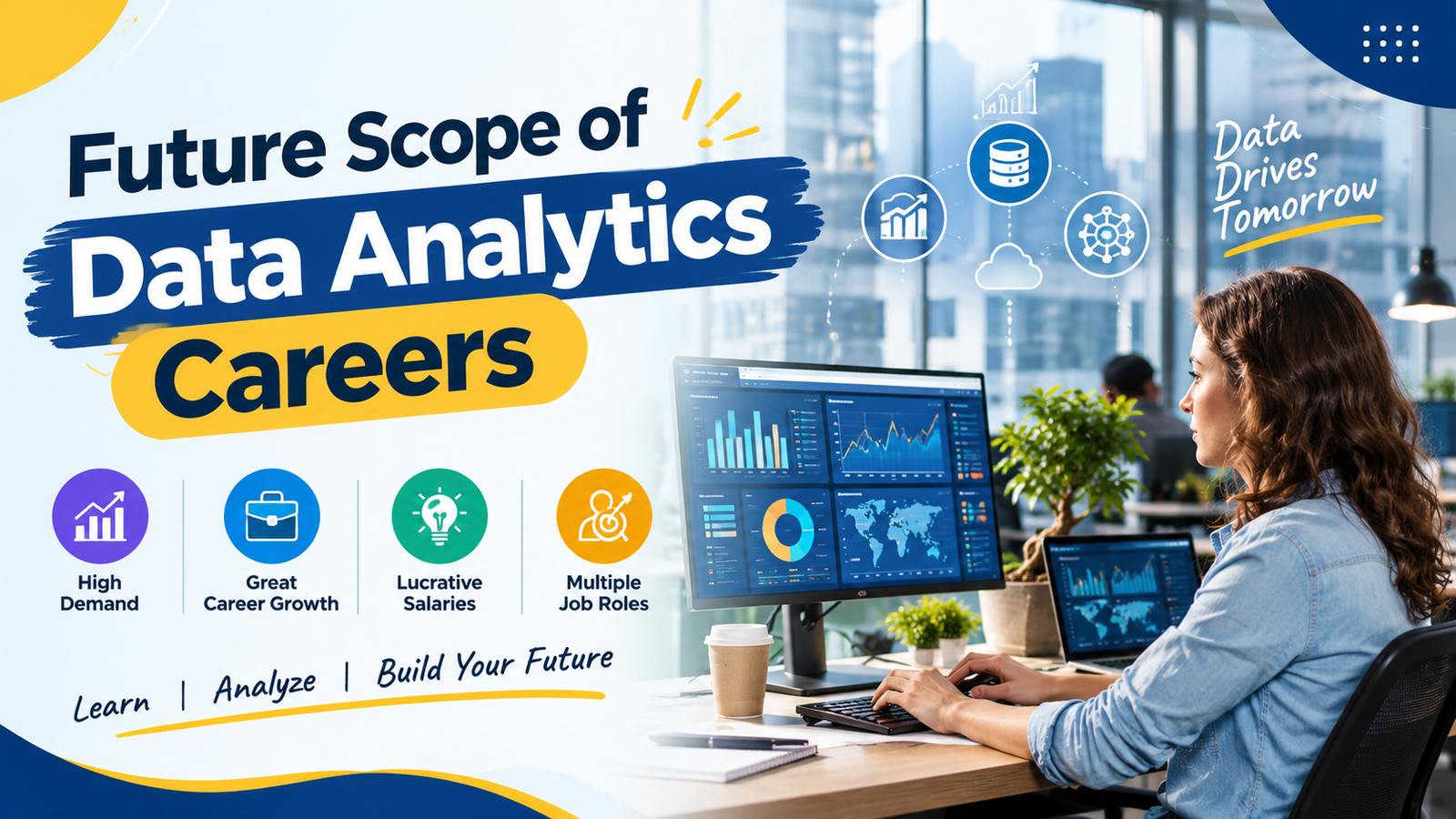
Data Analytics Career for Freshers: Skills & Growth

Future Scope of Data Analytics Careers: Opportunities, Skills & Growth

In today’s digital world, businesses generate huge amounts of information through websites, applications, online transactions, customer interactions, social media, and internal operations. However, raw data becomes valuable only when professionals can analyze it and turn it into meaningful insights. This growing need has made data analytics an attractive career option for students, graduates, and working professionals. The Future Scope of Data Analytics Careers looks promising because organizations across technology, banking, healthcare, retail, e-commerce, education, manufacturing, marketing, and logistics increasingly depend on data-driven decisions. As businesses adopt artificial intelligence and advanced digital tools, professionals who understand data can play an important role in helping organizations improve performance and make better decisions. For students and graduates, particularly those looking for technology-oriented careers, developing practical analytics skills can create several opportunities. Tech Spartans focuses on practical IT and technology education, helping learners understand industry-relevant tools and build skills that can support their professional goals.

What Is Data Analytics?

Data analytics is the process of collecting, cleaning, organizing, analyzing, and interpreting data to discover useful information. A data analyst may examine sales figures, customer behavior, website traffic, financial information, operational reports, or marketing performance. The purpose is not simply to work with numbers. The goal is to answer business questions and provide insights that help organizations make informed decisions. For example, a company may use analytics to understand: Which products generate the most revenue? Why are customers leaving? Which marketing campaign performs best? Which region has the highest sales? What factors are affecting business performance? This combination of technology, analytical thinking, and business understanding makes analytics valuable across many industries.

Future Scope of Data Analytics Careers

The Future Scope of Data Analytics Careers is expanding as organizations continue to generate and use larger volumes of information. Analytics is also becoming more closely connected with artificial intelligence, automation, cloud computing, and business intelligence. Modern analytics professionals may work with tools such as Excel, SQL, Python, Power BI, Tableau, databases, and cloud platforms. Entry-level roles often emphasize practical data handling, reporting, dashboards, and business insights, while advanced positions can involve predictive analytics, machine learning, and specialized analytics. Some major areas contributing to future growth include:

1. Business Intelligence

Companies need dashboards and reports that help managers understand important business metrics. Business Intelligence analysts use data visualization and reporting tools to convert complex information into understandable insights.

2. Artificial Intelligence and Automation

AI is changing how analysts work. Automated tools can assist with repetitive tasks, data preparation, reporting, and analysis. This means future analysts will increasingly need to combine traditional analytical skills with AI-assisted workflows. Rather than eliminating the importance of analysts, automation can allow professionals to spend more time interpreting results, asking better questions, and communicating recommendations.

3. E-Commerce and Customer Analytics

Online businesses collect information about customer searches, purchases, preferences, and interactions. Analytics can help organizations understand customer behavior, optimize marketing campaigns, improve product recommendations, and increase customer retention.

4. Healthcare Analytics

Healthcare organizations generate information from patient records, medical systems, research, and operations. Data analytics can help identify trends, improve resource planning, monitor performance, and support evidence-based decision-making.

5. Financial Analytics

Banks, financial institutions, and fintech companies use analytics for customer insights, risk assessment, fraud detection, forecasting, and performance analysis. This creates opportunities for professionals who combine analytics with financial knowledge.

Data Analytics Career for Freshers

A Data Analytics Career for Freshers can be a practical starting point for students and graduates interested in technology and business decision-making. Freshers do not necessarily need to master every advanced technology before applying for entry-level positions. A strong foundation in Excel, SQL, data visualization, basic statistics, and gradually Python can provide a useful starting point. Current career guides commonly identify Excel, SQL, BI tools, Python, and communication as valuable skills for entry-level analytics roles. Freshers can explore roles such as: Junior Data Analyst Data Analyst Reporting Analyst Business Intelligence Analyst Business Analyst Marketing Analyst Operations Analyst Financial Data Analyst MIS/Data Reporting Executive Product Analyst The exact requirements vary by company, so learners should focus on building demonstrable skills rather than relying only on certificates.

Skills Required for a Data Analytics Career

Building a successful Data Analytics Career for Freshers requires a combination of technical and soft skills.

Excel

Excel remains useful for organizing information, calculations, filtering, data cleaning, pivot tables, charts, and quick business analysis.

SQL

SQL helps analysts retrieve and manipulate information stored in relational databases. It is an important skill for many analyst positions.

Power BI or Tableau

Visualization tools help professionals create dashboards and communicate insights through charts and interactive reports.

Python

Python can be used for data cleaning, analysis, visualization, automation, and advanced analytics. Beginners can gradually learn libraries such as Pandas and NumPy.

Statistics

Basic statistics helps analysts understand averages, distributions, relationships, trends, and other patterns within datasets.

Communication

Technical knowledge alone is not enough. Analysts must explain their findings clearly to managers, clients, and other teams. Communication and business understanding are therefore important parts of an analytics career.

Career Growth After Becoming a Data Analyst

The Future Scope of Data Analytics Careers becomes even broader as professionals gain experience and specialize. A possible career progression can look like: Fresher → Junior Data Analyst → Data Analyst → Senior Data Analyst Analytics Lead → Analytics Manager Professionals can also move into specialized areas such as: Business Intelligence Product Analytics Marketing Analytics Financial Analytics Data Science Machine Learning Analytics Engineering Data Engineering This flexibility is one reason analytics can be attractive to professionals from different educational and industry backgrounds.

How Freshers Can Start Their Analytics Journey

Students interested in a Data Analytics Career for Freshers should follow a practical learning approach rather than trying to learn everything simultaneously.

Step 1: Learn Excel

Start with formulas, functions, sorting, filtering, pivot tables, charts, and basic data cleaning.

Step 2: Learn SQL

Practice SELECT statements, filtering, sorting, joins, grouping, aggregation, and subqueries.

Step 3: Learn Data Visualization

Create dashboards using Power BI or another business intelligence platform.

Step 4: Understand Python

Once the basics are comfortable, learn Python for data manipulation and analysis.

Step 5: Build Projects

Projects can demonstrate how you apply your skills. Examples include sales analysis, customer analysis, marketing campaign analysis, e-commerce dashboards, or financial reports.

Step 6: Prepare for Interviews

Practice SQL questions, Excel tasks, dashboard explanations, analytical case studies, and questions about your projects. Practical projects are particularly valuable because employers can evaluate what a candidate can actually do rather than looking only at a course certificate.

Why Choose Tech Spartans for Data Analytics Learning?

Tech Spartans is an IT training and education provider offering practical technology-focused learning. For students interested in developing analytics skills, a structured learning environment can make it easier to progress from fundamental concepts toward practical projects. A useful analytics learning program should focus on practical exercises, real-world datasets, data visualization, analytical thinking, and project-based learning. Students should also receive opportunities to practice the tools commonly used in entry-level analytics work. The objective should be to develop confidence in working with data and presenting meaningful insights—not simply completing a certificate.

Is Data Analytics a Good Career for the Future?

Yes, analytics offers strong long-term potential because businesses increasingly depend on measurable information for decision-making. The field is also evolving with AI, automation, cloud technologies, and advanced visualization. However, students should understand that completing a course alone does not guarantee employment. Building practical skills, completing projects, improving communication, staying updated with industry tools, and continuously learning are important for long-term success. The Future Scope of Data Analytics Careers will likely favor professionals who can combine technical knowledge with business understanding and critical thinking.

Frequently Asked Questions

1. What is the future scope of data analytics careers?

The future scope is broad because organizations across industries increasingly use data for business decisions. Opportunities are available in business intelligence, finance, healthcare, e-commerce, marketing, technology, operations, and other sectors.

2. Is data analytics a good career for freshers?

Yes. Freshers can enter through junior data analyst, reporting, MIS, business intelligence, or related roles. Developing practical skills in Excel, SQL, Power BI, and Python can improve their career prospects.

3. What skills should a fresher learn for data analytics?

Freshers should start with Excel, SQL, basic statistics, data visualization, and communication. Python can then be added for more advanced data analysis and automation.

4. Can non-technical students pursue data analytics?

Yes. Analytics is not limited to computer science graduates. Students from commerce, business, economics, mathematics, and other backgrounds can develop analytics skills. Practical ability and problem-solving are important considerations.

5. How can Tech Spartans help students learn data analytics?

Tech Spartans provides practical IT and technology-focused training. Students can use structured learning and project practice to develop relevant analytics skills and build a stronger foundation for technology-oriented career opportunities.

Get Directions

Share this SEO article
Spread the knowledge with your friends & colleagues